Is an Exclusive International Fund Worth It in 2026?
Quick answer
An exclusive international fund in Cayman costs US$ 55 thousand to US$ 150 thousand a year and, since 2024, Law 14,754/2023 taxes its profit on December 31 at 15%, as with a direct portfolio. It only pays for itself from about US$ 12 million, when governance, succession or co-investment justify the cost.
- Recurring cost
- US$ 55–150 thousandper year
- Income tax on profit
- 15%on Dec 31
- Minimum net worth
- US$ 12 millionat a US$ 60 thousand cost
- CIMA fee 2026
- US$ 4,125registered fund
- 01The Short Answer, Before the Long Math
- 02How Does Law 14,754 Tax an Exclusive International Fund?
- 03Bucket 1: Direct Financial Investment, With Deferral
- 04Bucket 2: Controlled Entity, Taxed Every December 31
- 05The Segregated-Class Detail That Catches Many People
- 06How Much Does It Really Cost to Maintain the Structure?
- 07The Math That Decides
- 08The Tax Transparency Option: The Deferral That Remains
- 09When Does Transparency Beat the Controlled-Entity Regime?
- 10Simulation With Numbers: US$ 20 Million Over Ten Years
- 11Exclusive International Fund, Direct Portfolio and Brazilian Fund Side by Side
- 12What Ancillary Obligations Come in the Package?
- 13When Does an Exclusive International Fund Really Pay Off?
- 14Consolidating Scattered Assets
- 15Succession Without Probate in Each Country
- 16Co-investment Between Families or Partners
- 17Access to Asset Classes Closed to Individuals
- 18Mistakes That Cost a Lot
- 19How Do You Dismantle the Structure When It Does Not Pay for Itself?
- 20Conclusion

An exclusive international fund costs between US$ 55 thousand and US$ 150 thousand a year to maintain in Cayman, and since January 1, 2024 it has lost the main reason it was sold in Brazil: tax deferral. Law No. 14,754/2023 (Lei 14.754/2023) began taxing the structure's profit on December 31 of each year, whether or not anything was distributed.
Anyone setting up the structure today pays the same 15% personal income tax (IRPF) they would pay on a portfolio at a private bank, only with a fixed six-figure dollar bill on top. There are still four situations in which the structure pays for itself, and none of them has anything to do with saving tax.
This guide shows the exact math: what it costs, what the law changed, which minimum net worth justifies the structure, and which ancillary obligations come with it. The regulatory fee figures come from the notice published by the Cayman Islands Monetary Authority itself in February 2026, and the tax deadlines come from the text of the law.
The Short Answer, Before the Long Math
| Situation | Recommended structure | Why |
|---|---|---|
| Assets abroad below US$ 5 million | Direct investment account | The fixed cost consumes more than the benefit |
| US$ 5 million to US$ 15 million, no partners | Direct account or simple LLC | Deferral only exists outside the controlled entity |
| Above US$ 15 million with heirs | Fund or PIC + succession planning | Governance and succession pay the bill, not the tax |
| Multiple families in the same vehicle | Regulated fund with segregated classes | Asset segregation by class is a practical requirement |
| Professional manager raising money from third parties | Fund regulated by CIMA | A regulatory requirement, not a choice |
The point almost no Portuguese-language material has updated: the rate is still 15%. Provisional Measure 1,303/2025 (Medida Provisória 1.303/2025), which would have unified the taxation of financial investments at 17.5% and then 18% in the rapporteur's text, expired on October 8, 2025 without being voted on. Anyone who made a decision in 2025 based on that measure was deciding on a rule that never took effect.
How Does Law 14,754 Tax an Exclusive International Fund?
The law split money abroad into two buckets with opposite treatments, and that is where the structure wins or loses.
Bucket 1: Direct Financial Investment, With Deferral
Article 3 covers interest-bearing deposits, securities, units of third-party open funds, digital wallets and interest-bearing current accounts. The 15% tax applies only "upon redemption, amortization, disposal, maturity or liquidation" - that is, at the moment the gain becomes cash. A portfolio bought and held for ten years generates no IRPF during those ten years.
Bucket 2: Controlled Entity, Taxed Every December 31
Article 5 reaches "companies and other entities, with or without legal personality, including investment funds and foundations" in which the individual holds more than 50% of the capital or the power to elect the majority of the directors. The profit of these entities "will be taxed on December 31 of each year," regardless of distribution.
Two filters in paragraph 5 decide who is caught: being in a favored-taxation jurisdiction or earning own active income below 60% of total income. An exclusive fund in Cayman fails both at once. Cayman is on the favored-taxation list, and paragraph 6 expressly excludes interest, dividends, rents and financial investments from the concept of active income - which is exactly 100% of what an investment fund does.
There is no exclusive international fund structure in a tax haven that escapes Article 5. Anyone who promises otherwise is selling risk.
The Segregated-Class Detail That Catches Many People
Paragraph 2 of Article 5 requires treating each class of units with segregated assets as a separate entity, including to test for control. SPC structures built to dilute ownership below 50% per class do not work: the test is run class by class. An investor with 100% of one class controls that class, even while holding 3% of the whole fund.

How Much Does It Really Cost to Maintain the Structure?
The regulatory fee is the small part and the only one with a published official value. The rest is market pricing, and it varies with the administrator, the volume and the complexity of the portfolio.
| Item | Annual cost (USD) | Nature |
|---|---|---|
| CIMA annual fee - registered fund | 4,125 | Official, revised in 2026 |
| CIMA annual fee - master fund | 3,075 | Official, revised in 2026 |
| Sub-fund or AIV of a private fund | 525 per vehicle | Official, revised in 2026 |
| Annual audit by an approved local auditor | 15,000 to 35,000 | Mandatory, no exemption |
| Fund administrator (NAV, KYC, AML) | 25,000 to 60,000 | Market |
| Two independent directors | 8,000 to 20,000 | Market |
| Registered agent and registry fee | 1,500 to 3,500 | Market |
| Outsourced AML officers | 5,000 to 15,000 | Regulatory requirement |
| FATCA and CRS reporting | 2,000 to 6,000 | Mandatory |
| Total recurring | 55,000 to 150,000 | - |
Setup is separate: the offering memorandum, incorporation, legal opinions and bank onboarding add up to US$ 40 thousand to US$ 100 thousand in the first year.
CIMA fees went up in 2026. The authority's notice raised the annual fee for a registered fund from 3,675 to 4,125 and for a master fund from 2,625 to 3,075, due on January 15 of each year, with a deadline until February 15, 2026 to pay the first-year difference. Anyone who budgeted the structure with 2024 numbers has a spreadsheet that is almost 12% out of date on that line alone.
The Math That Decides
The criterion I use with clients is simple: the annual fixed cost must not exceed 0.5% of the assets under management. Above that, the structure eats the return difference it was supposed to protect.
- •A cost of US$ 60 thousand a year requires about US$ 12 million under management
- •A cost of US$ 80 thousand a year requires about US$ 16 million
- •A cost of US$ 120 thousand a year requires about US$ 24 million
With US$ 3 million, a US$ 60 thousand structure consumes 2% a year - more than the management fee of any decent fund, with no tax gain in return. This threshold lines up with the reasoning in our guide on the net worth at which an offshore company is worth it, and the yardstick is the same: fixed cost divided by net worth, with no self-deception.
The Tax Transparency Option: The Deferral That Remains
Article 8 of the law is the part least explored by Portuguese-language content and the one that changes the result the most. It allows declaring "the assets, rights and obligations held by the controlled entity as if they were held directly by the individual." In practice, the vehicle disappears for tax purposes: each asset is treated under Article 3, with tax due on realization.
The price of this choice is in the following paragraphs, and it is high:
- •The option is irrevocable and irreversible for as long as the person holds that entity. There is no going back the following year.
- •It must be exercised entity by entity, not for the whole structure at once.
- •When there is more than one individual partner resident in Brazil, all of them must opt in together. One dissenting partner makes the choice unworkable for the others.
- •Under transparency, the possibility of offsetting results inside the entity disappears: each asset is assessed in isolation, under whichever rule applies to it.
When Does Transparency Beat the Controlled-Entity Regime?
A portfolio bought to be held for many years, with few liquidity events, tends to benefit: the tax follows the sale, not the calendar. A portfolio that turns over frequently, or has significant losses to offset, usually does better under the Article 5 regime, where the assessment is made on the entity's net profit.
The decision is final, which makes it a matter for a written opinion and not for a conversation in a meeting. Structures with different partners in the same entity need to align the choice before the first return, or risk a regime imposed by disagreement.
Simulation With Numbers: US$ 20 Million Over Ten Years
The following example uses conservative assumptions: initial net worth of US$ 20 million, gross return of 6% a year, structure cost of US$ 80 thousand a year, and no distribution to the unitholder during the period.
| Scenario | Tax over the ten years | Cost of the structure | Note |
|---|---|---|---|
| Cayman fund, Article 5 regime | 15% on each year's profit, paid every 12/31 | US$ 800 thousand | Prepaid tax reduces the base that keeps earning |
| Same fund, with the transparency option | 15% only on what is realized | US$ 800 thousand | Recovers deferral, loses internal offsetting |
| Direct portfolio at an international broker | 15% only on what is realized | Brokerage and custody | No audit, no director, no administrator |
The effect the spreadsheet reveals is that of prepaid tax: each payment on December 31 takes out of the portfolio an amount that would have kept earning in the following years. Over ten years of compounding, that difference usually far exceeds the operational savings the structure promises. When the client adds this to the US$ 800 thousand of accumulated cost, the question stops being a tax question and becomes a governance one: is there a corporate, succession or access problem that justifies this amount? If there is, the structure holds up. If there is not, comparing it with investing abroad in a structured but simple way tends to favor the direct route.
Exclusive International Fund, Direct Portfolio and Brazilian Fund Side by Side
| Criterion | Exclusive fund in Cayman | Direct portfolio abroad | Exclusive fund in Brazil |
|---|---|---|---|
| When the tax is due | 12/31 of each year | When the gain is realized | May and November (come-cotas) |
| Rate | 15% | 15% | 15% or 20%, plus regressive table on redemption |
| Deferral | No | Yes | No |
| Loss offsetting | Inside the entity | Between investments, under its own rule | Inside the fund |
| Annual cost | US$ 55 to 150 thousand | Brokerage and custody | 0.3% to 1.5% of net worth |
| Mandatory audit | Yes, local auditor | No | Yes |
| Succession protection | High, if well designed | Low | Medium |
| Reporting to Brazil | DAA, CBE, controlled-entity schedule | DAA and CBE | Administrator's statement |
Brazil's come-cotas is in Articles 17 and 18 of the same Law 14,754: withholding on the last business day of May and November, with a complement under the regressive table on exit. Comparing an "offshore company taxed every year" with a "tax-exempt Brazilian fund" means comparing against something that ceased to exist in 2024.
What Ancillary Obligations Come in the Package?
Three distinct reports, three authorities, three penalties.
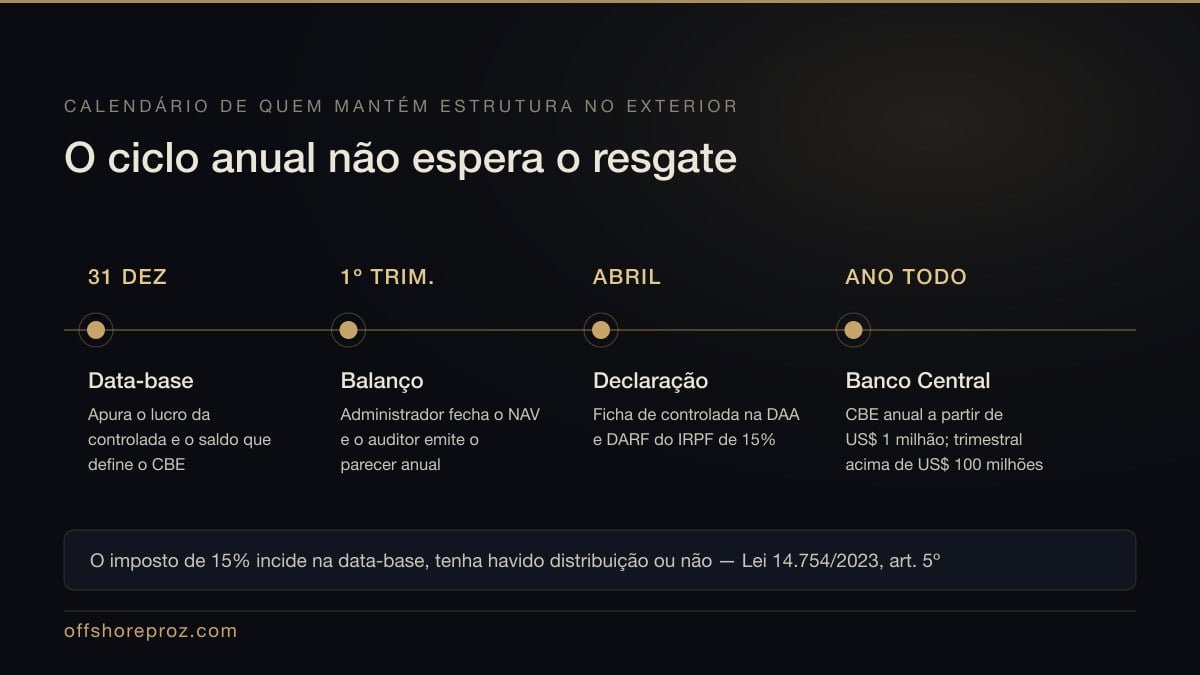
- •Annual Adjustment Return (DAA). Article 2 requires reporting income from financial investments and profits of controlled entities on separate schedules, with the entity's balance sheet drawn up on 12/31. RFB Normative Instruction 2,180/2024 details how to fill it out and the option for the tax transparency regime. Our step-by-step is in how to declare an offshore company on your income tax return.
- •CBE to the Central Bank. Mandatory for anyone with US$ 1 million or more abroad on the reference date of December 31, and quarterly for those above US$ 100 million on the reference dates of March, June and September. The filing calendar changes every year and is published on the official CBE page. Late filing brings a fine.
- •CRS and FATCA. The fund reports the ultimate beneficial owner to the Cayman authorities, who pass it to Brazil's Federal Revenue Service (Receita Federal) under the OECD standard. The information arrives before the taxpayer's return, not after.
The detail almost nobody anticipates is the order of events. The CRS report for December 31 reaches the Receita Federal the following year with balance, income and the identification of the ultimate beneficial owner - before the taxpayer files their own return. When the two numbers diverge, the cross-check does not depend on field inspection: the system compares two records that are already in the same database. Correcting on your own initiative, before any notice, costs a late-payment penalty on the tax due. Correcting after the notice is an assessment ex officio, with a fine at a different level and without the spontaneity that reduces the bill.
There is also an obligation that appears on no list because it is not the investor's: the fund itself must keep audited accounting and records up to date in its jurisdiction. If the administrator delays the NAV or the auditor delays the opinion, the Brazilian investor is left without the 12/31 balance sheet that the Receita Federal requires to assess the controlled entity's profit. The deadline of the person filing depends on a provider they do not control - and that is why changing administrators in the middle of the fiscal year is one of the most expensive decisions in this structure.
When Does an Exclusive International Fund Really Pay Off?
None of the four cases below has anything to do with paying less tax.

Consolidating Scattered Assets
An investor with accounts at four banks, in three jurisdictions and in two currencies has four sets of KYC, four reports and no consolidated view. Bringing everything into a single vehicle with an audited NAV solves governance, makes Lombard credit easier and produces a report that the Brazilian accountant can use. Above US$ 20 million, the administrative cost of the dispersion usually exceeds the cost of the fund.
Succession Without Probate in Each Country
An asset held directly in a foreign account may require succession proceedings in the bank's jurisdiction. Fund units, with a transfer policy defined in a document, pass without going through a foreign court. It is the same reasoning behind the structures described in the guide on offshore holding companies and asset protection, applied to a financial portfolio.
Co-investment Between Families or Partners
When three families enter the same vehicle, segregated classes with separate accounting handle entry, exit and dilution without renegotiating the contract at every movement. This is the case in which the regulated structure exists for a real legal reason, not for aesthetics. The particulars of the jurisdiction are detailed in investment funds in Cayman.
Access to Asset Classes Closed to Individuals
Private equity, structured credit and some hedge funds only accept institutional investors or require a minimum ticket incompatible with an individual. The vehicle opens the door - and here the economics are about access, not tax.
Mistakes That Cost a Lot
- •Assuming deferral in a controlled entity. The tax falls due on 12/31, with or without distribution, and without cash to pay it the investor has to redeem at the worst time.
- •Budgeting the structure without the annual audit. It is the second-largest item in the spreadsheet and has no exemption for a registered fund.
- •Using segregated classes to try to stay below 50%. Paragraph 2 of Article 5 tests class by class.
- •Forgetting the CBE because "the fund already reports." They are different authorities, with different bases and deadlines.
- •Keeping a structure inherited from before 2024 without review. Many PICs set up to defer tax became pure cost and should have been simplified.
- •Choosing the administrator on price. A NAV error or audit delay blocks redemptions and contaminates the return in Brazil.
How Do You Dismantle the Structure When It Does Not Pay for Itself?
A good share of the structures active today was built on a premise the law revoked. Dismantling is a legitimate decision, and the roadmap is well known.
The first step is about the calendar, not the lawyer. Regulatory fees and the administrator's fee are annual and fall due at the start of the fiscal year: a liquidation that crosses the new year makes the investor pay one more full cycle for an entity they have already decided to close. Anyone who starts the process in the second half of the year usually has room to finish; anyone who starts in December pays to wait.
The second step is the order of the write-offs. Assets must be sold or transferred to the investor's account before closing, because an entity in liquidation does not move its portfolio freely. Then come settling the providers, the auditor's final opinion and only then the formal dissolution in the jurisdiction. A regulated vehicle has one more stage: the local authority must accept the cancellation of the registration, and it does not accept it with a pending report.
The third step happens in Brazil. Liquidation is not a neutral event: the difference between the declared acquisition cost and the amount actually received is a capital gain, assessed in the month the funds become available, and the controlled entity's profit assessed up to the date of closure remains subject to the annual rule. Closing the entity does not erase the current year - it only ends the following ones.
There is an intermediate path that is rarely presented: keep the entity and change its clothes. A registered fund that becomes a closed investment company, with no offering to third parties, loses the regulatory fee and the audit obligation imposed on the regulated vehicle, keeping the same account and the same custodian. For anyone who needs the entity for succession reasons but not the regulatory framework, this is the adjustment that cuts most of the fixed expense without undoing what was built.
Conclusion
An exclusive international fund stopped being a tax-saving instrument for Brazilians in 2024 and became an instrument of governance, succession and access. With 15% falling every December 31 and a fixed bill that starts at US$ 55 thousand a year, the right question is not how much tax the structure saves, but which problem it solves that an investment account does not. If the answer is "none," the structure is an expense.
To size your specific case, comparing the structure with simpler alternatives for international tax planning and with the reality of the Cayman Islands, you can schedule a consultation and bring your portfolio numbers.
Need consulting?
Talk to a specialist via WhatsApp and clear your doubts about offshore structuring.
Talk on WhatsApp
Dr. Heitor Miguel
Attorney registered at OAB/SP 252,633. MBA in Business Law and M&A from FGV. Specialist in International Law and iGaming. President of the International Law Commission at OAB/SBC. Deal Maker of the Year 2014 – IAE Awards.
Is there still any legal deferral for people who invest abroad?
Yes, outside the controlled entity. Financial investments held directly by the individual follow Article 3 and are only taxed when the gain is realized. It is the path for those who invest with a long horizon and do not need a corporate vehicle.
What minimum net worth justifies setting up the structure?
By the yardstick of a 0.5% cost on net worth, somewhere between US$ 12 million and US$ 16 million for a regulated fund. Below US$ 5 million, the math practically never works out, except when there is a specific succession or corporate reason.
Will the rate go up to 17.5% in 2026?
Not through Provisional Measure 1,303/2025, which lapsed on October 8, 2025 without a vote. The Law 14,754 rate remains at 15%. Any future change requires a new law or a new approved provisional measure.
Can I offset a fund loss against a gain from another investment?
Offsetting happens within the assessment of the controlled entity, respecting the regime chosen in the return. The entity's losses do not automatically reduce gains from financial investments held in your own name.
Is Cayman the only viable jurisdiction for this type of vehicle?
No. Luxembourg, Ireland, the BVI and Singapore serve different profiles, with different cost and reputation. What does not change is the treatment in Brazil: if the entity is controlled and sits in a favored regime or has predominantly passive income, Article 5 applies all the same.
Does a structure set up before 2024 need to be dismantled?
Not always. If the original reason was only deferral, it became a cost with no counterpart and simplification makes sense. If succession, partners or access to assets are involved, the right move is to recalculate the spreadsheet with the 2026 fees before deciding.
Can the fund change jurisdiction without liquidating the structure?
Yes, and the mechanism is called continuation or redomiciliation: the entity migrates to another jurisdiction keeping its legal personality, history and accounts. In practice it requires a good-standing certificate from the original jurisdiction, acceptance of the registration at the destination, and agreement from the bank and the custodian, which redo KYC as if it were a new account. It is cheaper than liquidating and reconstituting when the problem is regulatory cost, and it solves nothing when the problem is the tax treatment in Brazil - that follows the substance of the entity, not its address.
Does the December 31 tax apply to profit that has not yet turned into cash?
Yes, and that is the point that surprises people most. The assessment takes the controlled entity's accounting profit in the annual balance sheet, regardless of distribution, redemption or any cash outflow. A portfolio that appreciated on paper generates tax in cash. That is why the practical rule is to keep enough liquidity for the April bill inside the structure itself: whoever does not set it aside ends up selling a position in January to pay the December tax, often at the worst moment in the market.
- Research
Law 14,754/2023 - taxation of financial investments and controlled entities abroad
www.planalto.gov.br
- Research
RFB Normative Instruction 2,180/2024 - regulation of Law 14,754
normas.receita.fazenda.gov.br
- Research
CIMA - revision of regulated fund fees, effective January 1, 2026
www.cima.ky
- Research
Central Bank of Brazil - Brazilian Capital Abroad (CBE)
www.bcb.gov.br
- Research
Chamber of Deputies - MP 1,303/2025 expires
www.camara.leg.br
- Research
Receita Federal - CRS and e-Financeira compliance
www.gov.br