Singapore Holding Company for Brazilians: ACRA, IRAS and Law 14,754
Quick answer
A Singapore holding company is registered with ACRA for $300 and requires a director who meets the local residency rules and a secretary. IRAS charges 17% on taxable income. In Brazil, Singapore is not in art. 1 of IN RFB 1,037, but a holding company with active income below 60% is taxed on December 31 (Law 14,754).
- Single corporate income tax rate (IRAS)
- 17%
- ACRA registration fee
- $300
- Minimum own active income to escape art. 5
- 60%of total income
- Annual CBE threshold on December 31
- US$1 million
- 01How do you set up a holding company in Singapore?
- 02Who can be a director and secretary?
- 03How does Singapore tax the holding company?
- 04Is Singapore a tax haven for Brazil's Federal Revenue Service?
- 05How does Law 14,754 tax a Brazilian who owns a holding company in Singapore?
- 06Does the Singapore holding company go into the CBE?
- 07When does Singapore make sense for a holding company?
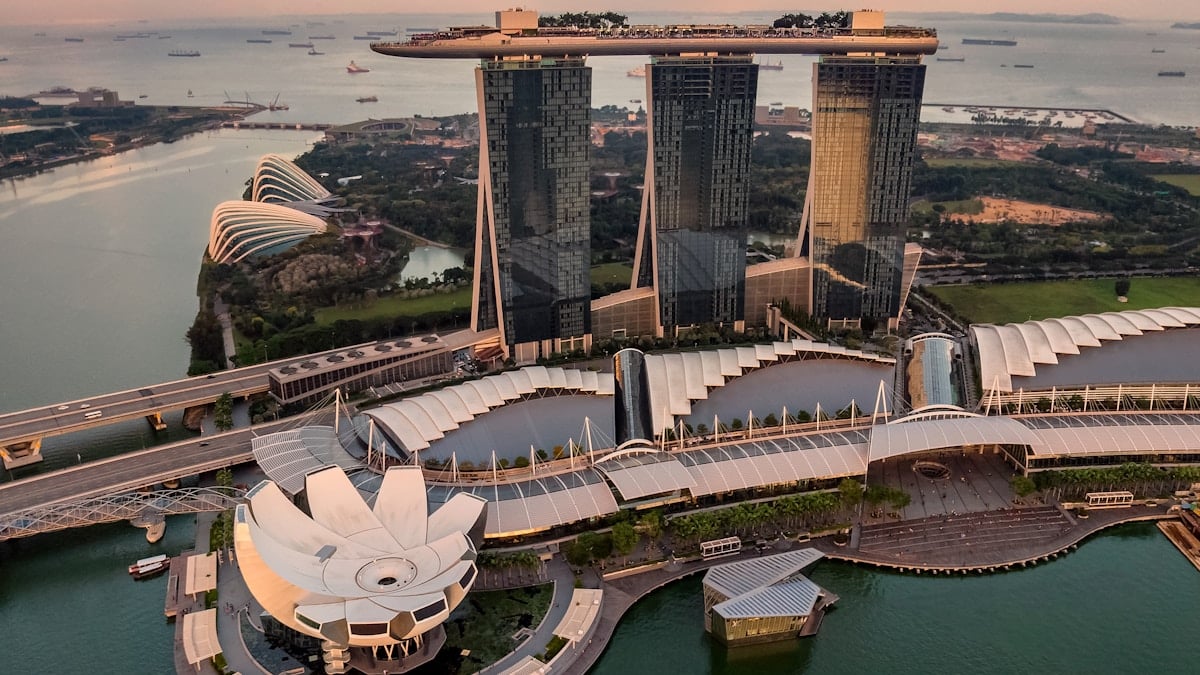
A Singapore holding company is registered with ACRA, with at least one director who meets the local residency rules, a secretary and a registered office in Singapore. IRAS charges 17% on taxable income. For Brazilians, Singapore left art. 1 of IN RFB 1,037, but Law 14,754 can still tax the profit on December 31.
This guide covers what is specific to Singapore. The general rules on holding companies for investing abroad are in holding company abroad for investments, and the choice between a holding and an offshore company is in the holding or offshore comparison.
How do you set up a holding company in Singapore?
Registration is done with ACRA (Accounting and Corporate Regulatory Authority) through Bizfile. First, you must reserve the company name. Only the person who reserved the name can register, and that person must be appointed a director or secretary. You can also hire a corporate service provider (CSP) to register on your behalf.
According to the ACRA page consulted on October 3, 2026:
- •the registration fee is $300, paid by card or internet banking;
- •most registrations are approved right after payment, and complex cases can take up to 15 business days;
- •registrations that depend on extra approval from authorities take 14 to 60 days;
- •the registered office must be a Singapore address, open to the public for at least three hours on each business day, and it does not have to be where you run the business.
These amounts and deadlines change. Check the ACRA page before settling a budget.
Who can be a director and secretary?
Every company needs at least one director and one secretary. According to ACRA, the director must be ordinarily resident, be 18 or older, and be a Singaporean citizen, a permanent resident or someone who meets the local residency rules. The secretary must be a natural person, also with local residence, and cannot be the same person as the sole director. The secretary must be appointed within six months after registration.
These requirements apply to the roles of director and secretary. Anyone who does not meet them must appoint another person who does, which is usually done through a CSP.
At registration, ACRA also asks whether the company is exempt from keeping the registers of nominee directors (ROND), nominee shareholders (RONS) and registrable controllers (RORC), which identify who actually controls the company. If there is no exemption, the company reports the data of the nominator and of the controllers.
How does Singapore tax the holding company?
According to IRAS, the company pays a single rate of 17% on taxable income, for both local and foreign companies. IRAS also describes exemption schemes, such as the one for new companies (start-up) and the partial one. They have limits in amount and duration, so consult the official page on rates and exemptions before estimating the tax.
For an investment holding company, the central point is income from outside Singapore:
- •foreign income is, in general, taxable in Singapore when sent to and received there;
- •if the income comes from a business carried on in Singapore, it is taxable when it accrues, even if not received;
- •companies that are tax resident in Singapore may have an exemption on dividends, branch profits and foreign-sourced service income when three conditions are met together: it has already been taxed in the country of origin, the maximum corporate income tax rate of that country is at least 15%, and the Comptroller considers the exemption beneficial;
- •double tax treaties benefit only tax residents of Singapore and of the partner country.
Do not assume the exemption applies automatically. It depends on the type of income and the country of origin, and should be checked case by case with a local accountant.
Is Singapore a tax haven for Brazil's Federal Revenue Service?
Not under art. 1 of IN RFB 1,037/2010. In the current text consulted on October 3, 2026, the item "Singapore (Cingapura)" appears as revoked by IN RFB 1,773/2017. Art. 1 now lists countries that do not tax income or tax it at less than 17%, or that do not provide access to the corporate ownership and the beneficial owner.
There is an important caveat in art. 2, XIV, which treats as a privileged tax regime some Singaporean regimes with a differentiated rate. Among them are those for insurers and reinsurers, the Finance and Treasury Centre, the trustee manager, income from debt securities and the financial sector incentive company. An ordinary holding company, with no specific incentive, is not on that list. Anyone who received a special incentive must check whether the regime appears in that item.
How does Law 14,754 tax a Brazilian who owns a holding company in Singapore?
The classification depends on the nature of the income and the regime, not only on the country. The company is controlled when you have a preponderant say in decisions or more than 50% of the capital or profits (Law 14,754, art. 5, § 1).
| Situation of the Singapore holding company | Taxation in Brazil | Basis |
|---|---|---|
| Own active income below 60% of total income (passive holding, with dividends, interest and investments) | Profit taxed on December 31, at 15%, without waiting for distribution | art. 2, § 1; art. 5, §§ 5, II, and 10 |
| Privileged regime of art. 2, XIV, of IN RFB 1,037 | Same December 31 rule | art. 5, § 5, I |
| Own active income of 60% or more and no privileged regime | Profit taxed when made available (profits determined since 2024), with the option to follow art. 5 | art. 6, II, and art. 6-A |
| Option for the transparency regime | The company's assets and rights declared as your own | art. 8 |
Art. 5, § 6, excludes royalties, interest, dividends, equity interests, rents, financial investments and financial intermediation from the concept of own active income. A holding company that only receives that income tends to fall below 60%.
The tax due in Singapore by the controlled company can be deducted from personal income tax (IRPF), in proportion to your stake and within the limits of art. 5, § 15. Keep the IRAS receipts. The transparency regime of art. 8 is irrevocable and irreversible as long as you hold the entity (art. 8, § 1, II). Run a simulation before opting.
Does the Singapore holding company go into the CBE?
Yes, when the total of Brazilian assets abroad reaches US$1 million or more on December 31. An equity interest in a non-resident company is one of the items to report, and the person responsible is the resident who holds it (BCB Resolution 279/2022, arts. 7, I, 8 and 10). The Central Bank sets the annual window from February 15 to April 5 and fines of BRL 2,500 to BRL 250,000.
When does Singapore make sense for a holding company?
Singapore requires a director and secretary who meet the residency rules, a local registered office and, after registration, annual general meetings and annual returns (ACRA). In return, there is a single 17% rate and the possibility of an exemption on certain foreign income, under IRAS conditions.
For a Brazilian's passive holding company, none of this changes the rule of art. 5 of Law 14,754, which looks at the nature of the income and not at the country. Singapore's advantage, when there is one, lies in governance and operations, not in Brazilian tax. Do not choose the country by reputation. Compare it with other jurisdictions on the pages for Singapore and Hong Kong, and see the corporate structures service. For a bank account, see offshore banking. The tax design is in tax planning and the filing routine in compliance.
Need consulting?
Talk to a specialist via WhatsApp and clear your doubts about offshore structuring.
Talk on WhatsApp
Dr. Heitor Miguel
Attorney registered at OAB/SP 252,633. MBA in Business Law and M&A from FGV. Specialist in International Law and iGaming. President of the International Law Commission at OAB/SBC. Deal Maker of the Year 2014 – IAE Awards.
How much does it cost to open a holding company in Singapore?
ACRA charges a $300 registration fee, according to its official page. CSP fees, a resident director, a secretary, a registered office address, an accountant and a bank are not included and vary by provider. Ask for a written quote.
How long does it take to register a company in Singapore?
ACRA states that most registrations are approved right after payment, that complex cases can take up to 15 business days and that registrations with extra approval from authorities take 14 to 60 days. Reserve the name first.
Can a Brazilian be a director of a company in Singapore?
Only if they meet the local residency rules required by the Companies Act, according to ACRA. Anyone who does not must appoint another person who does. ACRA's requirements cover the roles of director and secretary.
Is Singapore on the Federal Revenue Service's tax haven list?
Not in art. 1 of IN RFB 1,037/2010, where the item Cingapura was revoked by IN RFB 1,773/2017. Art. 2, XIV, however, treats some Singaporean regimes with a differentiated rate as a privileged regime. Check the current text.
Does Brazil tax the Singapore holding company's profit without distribution?
It depends. If the holding company has own active income below 60% or enjoys a privileged regime, the profit is taxed on December 31 at 15%, without waiting for distribution (Law 14,754, arts. 2 and 5). Outside those cases, the general rule is taxation when profits are made available (art. 6).
Do I need to declare the Singapore holding company to the Central Bank?
If your assets abroad total US$1 million or more on December 31, yes: the stake in the Singapore company goes into the annual CBE, filed from February 15 to April 5 of the following year. The fine ranges from BRL 2,500 to BRL 250,000.
- Research
ACRA, registering a local company via Bizfile
www.acra.gov.sg
- Research
ACRA, directors and other officers
www.acra.gov.sg
- Research
IRAS, corporate income tax rate and exemption schemes
www.iras.gov.sg
- Research
IRAS, companies receiving foreign income
www.iras.gov.sg
- Research
Law 14,754/2023
www.planalto.gov.br
- Research
IN RFB 1,037/2010
normas.receita.fazenda.gov.br
- Research
Central Bank of Brazil, CBE
www.bcb.gov.br