Business Bank Account in Mexico: Where the Process Stalls
Quick answer
No Mexican federal rule requires a Mexican apoderado, but BBVA's digital channel does. The account stalls on the RFC, the e.firma and the bank's review, which has no legal deadline. Keeping the company and account costs MXN 10,426 to 29,746 per year, before the Brazilian taxes.
- Recurring annual cost (floor)
- MXN 10,426 to 29,746per year
- RNIE registration deadline
- 40business days
- Presumption of control for the bank (propietario real)
- 25%
- Own active income test under Law 14,754
- 60%
- 01Why is the bottleneck at the bank and not the notary?
- 02What changed in 2026 that broke the old playbook?
- 03Can the SAT now expressly refuse RFC registration?
- 04Did the procedure forms change numbers?
- 05Were the controlling-beneficiary fines reindexed?
- 06What does the law require the Mexican bank to demand?
- 07Which documents does the Mexican bank require from the legal entity?
- 08Propietario real: three different cutoffs on the same ownership chain
- 09Does the personal interview mean, by law, going to the branch?
- 10What is the Lista de Personas Bloqueadas and how long is the defense period?
- 11Who can be the legal apoderado of a business bank account in Mexico?
- 12What is the path, step by step, with the official deadline?
- 13How much does it cost per year to keep the company and the account alive?
- 14Mexico or a US LLC: what does the cost account not show?
- 15What calendar takes effect the day after the account opens?
- 16What does Brazil charge whoever controls the Mexican legal entity?
- 17How does it go wrong: what are the four failure modes?
- 18When should you not open one: what filters before spending on a fedatario?
- 19Conclusion

A business bank account in Mexico is the step that stalls the project of a non-resident Brazilian, not the act of incorporating the company. What the bank asks for is not counter policy: it comes from the Disposiciones de carácter general a que se refiere el artículo 115 de la LIC.
Those rules call for an active RFC with homoclave, a Cédula de Identificación Fiscal, a valid e.firma and an apoderado (legal attorney-in-fact) whom the institution agrees to interview.
Counter policy is something else, and it has a name. BBVA México's digital channel requires an apoderado with "Nacionalidad mexicana", "Clave Única de Registro de Población (CURP)" and "e.firma vigente", plus annual sales between 130 and 2,500 million pesos - verified on the official page on September 26, 2026. No Mexican federal rule imposes nationality on the apoderado of a Mexican company.
This guide covers the account, not the deed: the corporate side is in opening a company in Mexico. The numbers come from the Official Gazette, SAT forms and the banks' own pages. Where a value is a market price, the sentence says so.
Why is the bottleneck at the bank and not the notary?
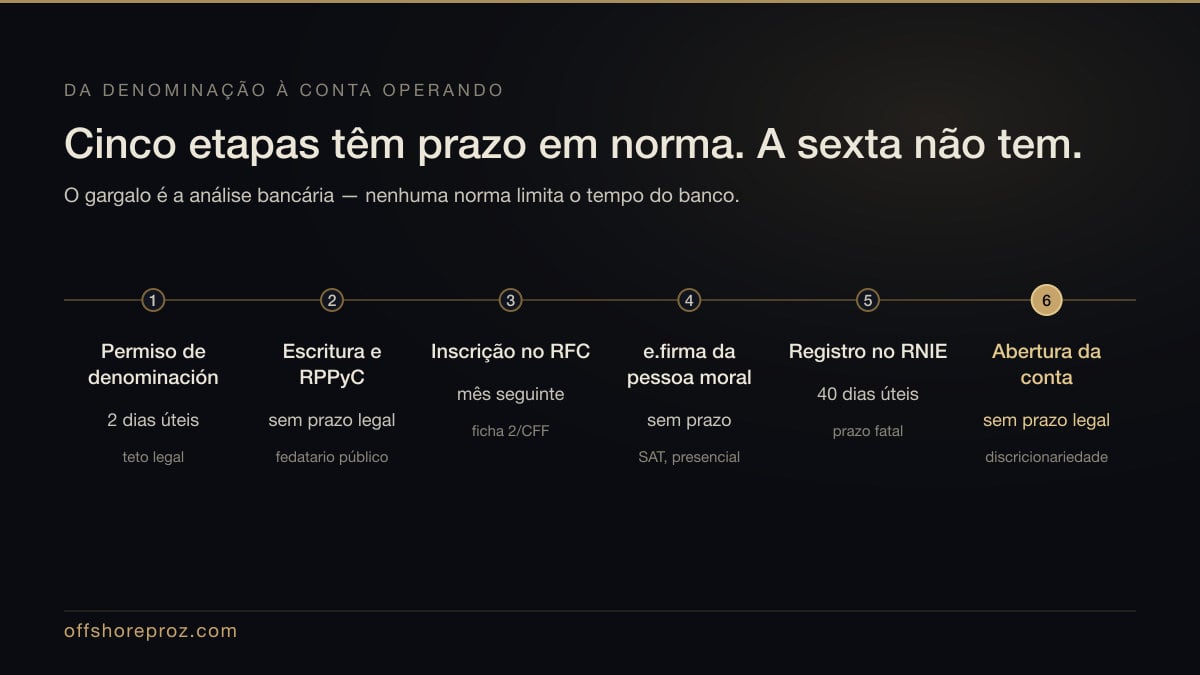
Of the six steps until the account operates, five have a deadline set by a rule and one has none: the bank's review. Each earlier link depends on an individual with a documented immigration status and a clean tax history in Mexico, and that dependency is what pushes the schedule from weeks to months.
| Step | Who handles it | Deadline | Where it stalls |
|---|---|---|---|
| Permiso de denominación | Secretaría de Economía (MUA) | 2 business days, legal cap | request requires someone's e.firma |
| Deed and registration in the RPPyC | public fedatario | no legal deadline | apostille and translation of the Brazilian power of attorney |
| Registration in the RFC (form 2/CFF) | SAT | month following the 1st obligation | refusal under art. 27, apartado C, fr. XIV |
| e.firma of the legal entity | SAT, in person | no deadline; depends on appointment availability | legal representative needs their own CURP and e.firma |
| Registration in the RNIE | Secretaría de Economía | 40 business days, hard deadline | forgotten in the schedule |
| Opening the account | bank | no legal deadline | apoderado, interview and propietario real |
Only one row has a short legal deadline, and it is not a banking one. The bank has no deadline at all - it has discretion, and uses it. The RNIE alone already consumes about eight calendar weeks, and the bank review adds an interval that no rule limits.
What changed in 2026 that broke the old playbook?
Three changes dated in the Official Gazette have applied since 2026: the SAT can now refuse RFC registration because of the tax history of a partner or legal representative, the procedure forms were renumbered - 43/CFF became 2/CFF - and the controlling-beneficiary fines rose to as much as MXN 2,249,000 per beneficiary.
Can the SAT now expressly refuse RFC registration?
The decree published in the DOF of November 7, 2025, evening edition, note 5772358, added - not reformed - article 27, Apartado C, fracción XIV of the Código Fiscal de la Federación . The text authorizes the authority to "Negar la inscripción de personas morales en el Registro Federal de Contribuyentes, cuando detecte que su representante legal" or "algún socio o accionista o cualquier persona que forme parte de su estructura orgánica" falls within the cases of articles 17-H, fractions X to XIII, or 69, twelfth paragraph, and "que no haya corregido su situación fiscal". It also reaches anyone who is "forme parte de otra persona moral" in the same condition.
The effective date is in Transitorio Primero: "El presente Decreto entrará en vigor el 1 de enero de 2026, salvo lo dispuesto en el artículo 30-B de este ordenamiento, el cual entrará en vigor el 1 de abril de 2026". Whoever receives the "Acuse del artículo 27, apartado C, fracción XIV, del CFF" has "diez días contados a partir del día hábil siguiente" to rebut the situation, under regla 2.4.17 and form 167/CFF (First Amendment to Annex 2 of the RMF 2026, DOF July 17, 2026, p. 668). The order of the project is inverted: one partner's tax history kills the structure before the bank does, because without an RFC there is no e.firma for the company and no Constancia de Situación Fiscal.
Did the procedure forms change numbers?
In the Resolución Miscelánea Fiscal for 2026 the old Annex 1-A became Annex 2, "Trámites Fiscales" (DOF of December 29, 2025, code 5777477; RMF published on December 28, 2025), and the forms were renumbered. Registration of the legal entity is no longer "43/CFF" and is now form 2/CFF, "Solicitud de inscripción en el RFC de personas morales en la ADSC". Citing 43/CFF in 2026 is citing something else: that number now designates the clarification for someone who corrected their tax situation.
On the current form, three points matter to Brazilians:
- •Monto: "Gratuito". There is no government fee for RFC registration. A fee charged by whoever prepares the document and follows the procedure is a service and may be charged; what should not exist is a "SAT fee" embedded in the proposal. Ask for a breakdown between the official fee, which here is zero, and the professional fee.
- •Deadline: "Dentro del mes siguiente al día en que deban presentar declaraciones periódicas, de pago, o informativas por si mismas o por cuenta de terceros o deban expedir comprobantes fiscales".
- •Partners abroad: the form requires "la clave en el RFC válida, de cada uno de los socios, accionistas o asociados" in a list in .xlsx format, but those who reside abroad and are not required to register use a generic RFC - "Personas físicas: EXTF900101NI1. Personas morales: EXT990101NI1."
The Brazilian partner, under the general rule, does not need their own RFC. The one who needs an RFC, CURP and e.firma is the legal representative, and that is where immigration status enters the project.
Were the controlling-beneficiary fines reindexed?
Annex 5 of the RMF 2026 (DOF of December 28, 2025, code 5777219) updated the fines in article 84-N of the CFF for inflation.
| Infraction (art. 84-N) | Range through 2025 | Range since 2026 |
|---|---|---|
| Failing to obtain, keep or submit the information | $1,500,000.00 to $2,000,000.00 | $1,686,750.00 to $2,249,000.00 |
| Failing to keep the information up to date | $800,000.00 to $1,000,000.00 | $899,600.00 to $1,124,500.00 |
| Submitting it incompletely or inaccurately | $500,000.00 to $800,000.00 | $562,250.00 to $899,600.00 |
At the DOF exchange rate of 17.6425 pesos per dollar recorded on September 25, 2026, the minimum fine in the first range is equivalent to about US$ 95.6 thousand - our conversion of the two official values. The unit of charge is what matters: the fine is per controlling beneficiary, not per company.
What does the law require the Mexican bank to demand?
The list of documents the bank asks for to open a business bank account in Mexico is not each institution's commercial policy: it comes from the Disposiciones de carácter general a que se refiere el artículo 115 de la Ley de Instituciones de Crédito . What changes among BBVA, Citibanamex and the others is the minimum balance, the fee and the service channel, not the file.
Which documents does the Mexican bank require from the legal entity?
The 4th disposición, fraction II, requires recording the name, line of business, nationality and "clave del Registro Federal de Contribuyentes (con homoclave) y, en su caso, número de identificación fiscal y/o equivalente, así como el país o países que los asignaron" - that passage is what makes the manager ask for the CNPJ of the Brazilian parent or the partner's CPF.
| Document | What the rule requires, in its text |
|---|---|
| Articles of incorporation | "Testimonio o copia certificada del instrumento público que acredite su legal existencia inscrito en el registro público que corresponda" |
| Tax registration | "Cédula de Identificación Fiscal expedida por la Secretaría" |
| Address | proof of the legal entity's address |
| Powers | "Testimonio o copia certificada del instrumento que contenga los poderes del representante o representantes legales, expedido por fedatario público" |
| Ownership chain | "su estructura accionaria o partes sociales" and, outside low risk, an organization chart with the general manager, the line immediately below and the board |
A power of attorney by private instrument, even with a signature notarized in Brazil, does not meet the rule, which requires an instrument issued by a fedatario. That does not oblige you to grant the power in Mexico: the accepted path is a power of attorney drawn up by public deed in Brazil, apostilled, translated by a sworn translator and filed before a Mexican fedatario. Confirm with the bank which powers must appear in the text before spending on the apostille and translation.
The 28th classifies as high risk, by rule, "los Clientes no residentes en el país" served in private banking, and obliges the institution to record "las razones por las que estos han elegido abrir una cuenta en territorio nacional" - bring the written justification. Two points that save a wasted trip:
- •A legal representative outside Mexico and without a passport: accepted only with an original official document from the country of origin, valid, with photo and signature.
- •A company not yet registered in the public registry: may be accepted upon a written commitment to register later, because the rule provides for the situation - which does not prevent the bank from refusing under internal policy.
Propietario real: three different cutoffs on the same ownership chain
A propietario real, for the Mexican bank, is the individual who directly or indirectly holds 25% or more of the capital or voting rights: "se entenderá que ejerce Control aquella persona física que directa o indirectamente, adquiera el 25% o más de la composición accionaria o del capital social", a paragraph added in the D.O.F. of April 25, 2014. If no one is above that, control is presumed to lie with the administrator. Since the reform in the D.O.F. of March 22, 2019, the rule does not require a "signed" declaration, but "una declaración por escrito, por medios electrónicos, ópticos o por cualquier otra tecnología"; and faced with a sign of falsity the bank's duty is "tomar medidas razonables para determinar e identificar a los Propietarios Reales", not an unrestricted investigation.
The same group of partners is measured by three different rulers:
| Regime | Control cutoff | Legal basis |
|---|---|---|
| Banking anti-money-laundering (propietario real) | 25% of capital or voting rights | Disposiciones art. 115 LIC, 4th |
| Tax (beneficiario controlador) | more than 15% of capital, by vote | CFF, art. 32-B Quáter |
| Vulnerable activities (LFPIORPI) | more than 25% of capital | LFPIORPI, reform of July 16, 2025 |
A partner with 18% is a controlling beneficiary for the SAT and does not reach the bank's 25% presumption. The percentage, however, is the most visible door, not the only one: the CFF itself also defines control as whoever can "imponer, directa o indirectamente, decisiones en las asambleas generales de accionistas, socios u órganos equivalentes" or "nombrar o destituir a la mayoría de los consejeros". A shareholders' agreement and de facto management count on both sides, and 25% is a presumption, not a ceiling. Anyone who builds the picture looking only at the banking percentage discovers the difference in the tax notice, with a deadline of 15 business days extendable by 10.
Does the personal interview mean, by law, going to the branch?
The 7th disposición says: "Antes de que una Entidad establezca o inicie una relación comercial con un Cliente, aquella deberá celebrar una entrevista personal con este o su apoderado, a fin de que recabe los datos y documentos de identificación respectivos y asentará de forma escrita o electrónica los resultados de dicha entrevista." The interview may be with the apoderado, and the record may be electronic. A branch does not appear in the text.
Since the resolution published in the DOF of August 28, 2024 there is an even more direct path: the 4th Ter allows entities to open accounts "a través de Dispositivos de forma no presencial a Clientes personas físicas o morales", with geolocation, biometric verification, e.firma and consent of the legal representative, applying technological mechanisms authorized by the CNBV "en sustitución de la entrevista" . The videoconference under the 7th-1, however, does not solve it for a company: it reaches only individuals of Mexican nationality resident in the country.
In commercial practice, BBVA closes the PyME dollar account flow by sending the applicant to a branch ("Si cumples con todos los requisitos acude a una sucursal BBVA."). That is product design, not a regulatory imposition: what usually requires presence is the channel, and the same bank's business banking is not tied to the website flow.
What is the Lista de Personas Bloqueadas and how long is the defense period?
If the client's name appears on the list, the 72nd orders "Suspender de manera inmediata la realización de cualquier acto, Operación o servicio" and to send the Secretaría, through the Comisión, a report of an Operación Inusual. The list is fed, among other sources, by United Nations Security Council resolutions 1267 (1999) and 1373 (2001): international sanctions enter the Mexican bank's filter without passing through a local judge. Much of the Portuguese-language material states ten business days to request a hearing. The deadline for the request is different.
| Act | Deadline | By whom |
|---|---|---|
| Suspension of any act, operation or service | immediate | bank |
| Report of an Operación Inusual to the Secretaría, through the Comisión | 24 hours | bank |
| Request for a hearing before the UIF, from the day after notification | 5 business days | client |
| Statement and evidence within the granted hearing | 10 business days, extendable once | client |
| UIF resolution, after the file is complete | 15 business days | UIF |
The five days come from the decree published in the DOF on March 11, 2022, which added article 116 Bis 2 to the Ley de Instituciones de Crédito; Transitorio Tercero repealed the 73rd, the basis of the old deadline. Always confirm the deadline written in the notice you receive, which prevails over any summary.
Who can be the legal apoderado of a business bank account in Mexico?
No Mexican federal rule requires an apoderado of Mexican nationality. The Ley de Inversión Extranjera says the opposite in article 4 - "La inversión extranjera podrá participar en cualquier proporción en el capital social de sociedades mexicanas" - and the reservations in article 6 reach domestic land transport, development banking and professional services, not the management of an ordinary company. The barrier is a banking-channel one, which explains why the request can be resubmitted through business banking. It creates no right, however: admitting a client is the bank's decision, and it may refuse without giving reasons.
The requirements of BBVA México's online channel, verified literally on the official page on September 26, 2026 :
| Block | Literal requirement |
|---|---|
| Legal apoderados | "Nacionalidad mexicana"; "Credencial de elector vigente"; "Clave Única de Registro de Población (CURP)"; "e.firma vigente (Firma Electrónica Avanzada)" |
| Company | "No tener una cuenta empresarial con nosotros"; "Residencia fiscal en México"; "Ventas anuales entre 130 y 2,500 millones de pesos" |
| Documents | "Acta constitutiva y poderes de representación legal"; "Cédula de Identificación Fiscal"; "Comprobante de domicilio fiscal (no mayor a 3 meses de antigüedad)."; "Comprobante de la generación de la e.firma (emitido por el SAT)." |
The sales range is 130 to 2,500 million pesos, that is, from 130 million to 2.5 billion: a newly incorporated company is outside the channel because of revenue, before the nationality discussion even starts. Where each door accepts, or does not accept, a foreign legal representative - position on September 26, 2026:
| Channel | Foreign apoderado | What it requires |
|---|---|---|
| BBVA, digital channel | no; requires "Nacionalidad mexicana" | CURP, credencial de elector, e.firma and the sales range above |
| BBVA, in-person business banking | case by case | notarized powers, with foreign-exchange powers on the PyME dollar account |
| Citibanamex, branch | case by case | "Acta Constitutiva y Poderes Notariados"; for a foreigner, "Pasaporte y Forma Migratoria" [?](https://www.banamex.com/es/centro-de-ayuda/procesos-sucursales/apertura-de-productos-en-sucursal/requisitos-para-la-apertura.htm "Citibanamex |
| Non-in-person flow under the 4th Ter | depends on the bank adopting it | geolocation, biometrics, e.firma and consent of the legal representative |
Alternatives that often unlock the case, with no guarantee of acceptance:
- •Appoint an apoderado resident in Mexico, with a CURP and e.firma, by a power restricted to opening and operating the account. BBVA requires "poder de los representantes con facultades para suscribir y emitir títulos de crédito" on the PyME dollar account, and that is a power to commit assets, not a decorative one. Offset it in the instrument itself: a fixed term, a value cap, joint signature above a floor and a registered revocation.
- •Go through the in-person business banking channel with the foreign legal representative, knowing that a passport alone is not enough at Citibanamex.
- •Ask for the non-in-person flow under the 4th Ter from a bank that has already implemented it. The rule authorizes it; adoption is the institution's option.
- •Check the regulatory news before choosing the institution. On June 26, 2025 the CNBV decreed a temporary management intervention (intervención gerencial temporal) at CIBanco and Intercam, under article 129 of the LIC , and FinCEN orders restricting certain fund transmissions with CIBanco, Intercam and Vector took effect on October 20, 2025 . Situations like these evolve: confirm the current status with the CNBV before deciding.
What is the path, step by step, with the official deadline?
The account only goes into review after five milestones, and the bank reads the result of all of them. The full incorporation roadmap is in opening a company in Mexico; here are the deadlines that define the account's calendar. Only the permiso has a short legal deadline - two business days as a cap. The RNIE is not short: it is a hard deadline.
Permiso de denominación. Homoclave SE-09-041, Dirección General de Normatividad Mercantil, single requirement "e.firma", "Tiempo de respuesta: 2 Días hábiles", "Vigencia: 180 Días naturales", through the portal mua.economia.gob.mx . Three points that Portuguese-language material repeats wrongly:
- •The two days are the cap in article 8 of the Reglamento para la Autorización de Uso de Denominaciones y Razones Sociales (DOF September 14, 2012); the system usually responds in minutes.
- •The 180 calendar days are the period in article 24 for the fedatario to give the Aviso de Uso, not the validity of the name. Once the period is lost, article 26 admits a late notice within thirty calendar days upon payment of derechos, with loss of the exclusivity reservation.
- •Whoever has no electronic signature can request support, in a free-form written request, from a public servant at a Secretaría module, who acts "en nombre y por cuenta" of the applicant (article 23), with the exception of the S.A.S.
Deed and registration. A document and power granted in Brazil need a Hague apostille, translation by an expert and filing before a Mexican fedatario. Three queues in series, none with a legal deadline - the stretch that consumes the most calendar time.
RFC under form 2/CFF. Free, with the list of partners in .xlsx and a generic RFC for those who live abroad. The e.firma of the legal entity, next, only issues if the legal representative already has an active e.firma as an individual, which requires a prior appointment, valid official ID, CURP and a USB device: it is the immigration link of the whole chain.
RNIE in 40 business days. The Ley de Inversión Extranjera requires registering the company with foreign participation "dentro de los 40 días hábiles contados a partir de la fecha de constitución de la sociedad o de participación de la inversión extranjera" (article 32), and article 34 obliges the fedatario to require proof of registration.
The recurring RNIE is lighter than advertised. The Reglamento requires an update notice "dentro de los diez días hábiles siguientes al cierre del trimestre", but the Resolución General published in the DOF of February 23, 2015 set thresholds: a change in capital or shareholding structure only triggers a notice above "veinte millones de pesos 00/100 Moneda Nacional ($20'000,000.00 M.N.)" in absolute value, and the same applies to income and outflows; the annual renewal of the constancia is only required when total assets, total liabilities, income or outflows exceed "ciento diez millones de pesos" in the fiscal year . For the typical Brazilian SME, neither is triggered - and that annual renewal is not an additional burden on top of the annual information, it is the same thing, split by article 43 between April (A-J) and May (K-Z).
With no threshold at all are a change of name, of economic activity and of tax domicile, which trigger a quarterly notice at any amount. The penalty in article 38, fraction IV, of the LIE is "multa de treinta a cien salarios", with no conversion published here because the text still defines "salario" as the daily minimum wage of the Distrito Federal, a base replaced by the UMA by a de-indexation decree. For the typical SME, the LIE fine is theoretical; the notice for a change of tax domicile is not.
How much does it cost per year to keep the company and the account alive?
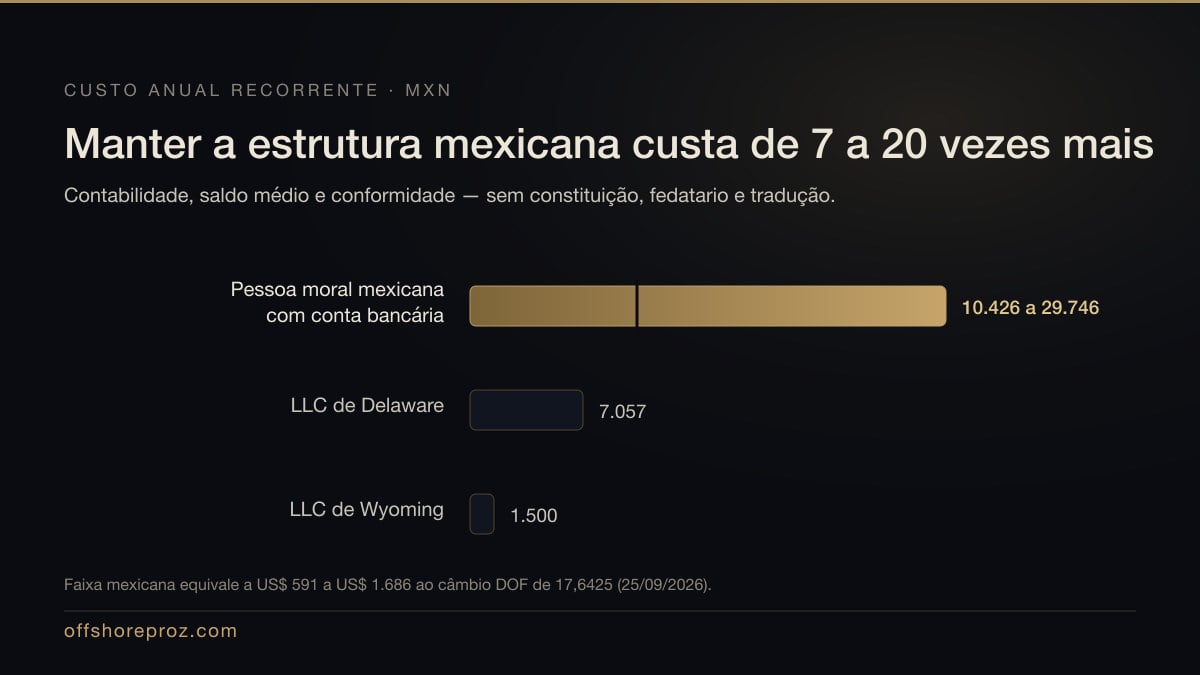
The minimum verifiable recurring cost of a legal entity with an open account, with no employees and without the annual return, is between MXN 10,426 and MXN 29,746 per year, or US$ 591 to US$ 1,686 at the DOF exchange rate of 17.6425 recorded on September 25, 2026 .
| Recurring item | Annual amount (MXN) | Nature of the data |
|---|---|---|
| Accounting - option A: assisted plan (MXN 749/month + IVA; annual return charged separately) | 10,426 | Konta public price list, consulted on September 26, 2026 |
| Accounting - option B: custom plan (MXN 1,749/month + IVA; annual return included), alternative to option A | 24,346 | Konta public price list, consulted on September 26, 2026 |
| Penalty for minimum average balance on BBVA's Cuenta Maestra Pyme (MXN 450/month) | 5,400 | bank fee schedule, consulted on September 26, 2026 |
| Recurring total (option A or B, plus the penalty) | 10,426 to 29,746 | our sum |
| Tax domicile, local apoderado, fedatario, apostille and translation | outside the table | quoted case by case |
The two accounting rows are alternatives and are not added together; the total combines one of them with the bank penalty . Treat the number as a partial floor, not as a budget: outside it are the fedatario, public registry, apostilles, translations, local apoderado and the annual balance sheet that IN RFB 2,180/2024 requires from whoever controls the company from Brazil. Mexican accounting firms advertise fees of MXN 3,000 to 12,000 per month for normal operation - a market price, not official data; the MXN 749 plans suit a company with no payroll and few supporting documents.
The dollar account follows the same logic: BBVA advertises a minimum initial deposit of 1 dollar on the Maestra Dólares PyME, a reference average balance of 1,200 dollars and a fee of 33 dollars when the balance falls below it, according to the product page consulted on September 26, 2026 . The cost is not in opening; it is in maintaining a company that bills little.
Mexico or a US LLC: what does the cost account not show?
A Wyoming LLC costs US$ 100 once for the Articles of Organization and US$ 60 per year of minimum annual report license tax , plus about US$ 25 per year for a registered agent - the latter is a private provider's price, not a state fee. Delaware charges "an annual tax of $400.00" per LLC, due "on or before June 1st" and, if late, "a penalty of $200.00 plus 1.5% interest per month"; and does not require an annual report for an LLC . There is, in the inputs used here, no Delaware registered agent price.
| Vehicle | Recurring state cost | In pesos, at the DOF rate 17.6425 | Note |
|---|---|---|---|
| Mexican legal entity with an account | MXN 10,426 to 29,746/year | 10,426 to 29,746 | provider accounting plus bank penalty |
| Wyoming LLC | US$ 60/year legal minimum + US$ 25/year agent, market price | ≈ 1,500 | US$ 100 opening, one time |
| Delaware LLC | US$ 400/year annual tax | ≈ 7,057 | no annual report; being late costs US$ 200 plus 1.5% per month |
Keeping the Mexican one costs 7 to 20 times a Wyoming LLC - detailed comparison in Wyoming or Delaware LLC and in how much it costs to open an offshore.
The American cost is not zero, and corporate cost is not total cost. A foreign-owned single-member LLC must file a pro forma Form 1120 with Form 5472 attached, with no electronic transmission, under a penalty of US$ 25,000, renewable every 30 days after 90 days from the IRS notice . For a resident of Brazil, the comparison only closes after the treatment under Law No. 14,754/2023 (Lei 14.754/2023), which classifies each vehicle by its own criteria: if the structure falls under the automatic regime, the profit is taxed on December 31 even without distribution, and that can invert the cost conclusion. Which one comes out cheaper requires a case-by-case calculation, not a table.
And the point most often misread: FinCEN exempted companies formed in the United States from the beneficial ownership report, with the final rule effective on August 14, 2026 , while Mexico tightened its controlling-beneficiary regime. That is administrative burden before an American regulator, not confidentiality. Accounts at Mexican and American banks are reportable to Brazil under automatic information exchange agreements, and the resident remains obliged to report the interest, the profit and the CBE. Choosing a jurisdiction for secrecy is a wrong premise and creates liability.
What calendar takes effect the day after the account opens?
With the business bank account in Mexico open, the legal entity's tax calendar at the SAT begins: from then on there is a monthly obligation for ISR, IVA, electronic accounting and the payments complement, plus the annual return by March 31, each with a fixed legal deadline and listed in the table below. Corporate ISR is 30% of the taxable result, general IVA is 16%, the ISR provisional payments fall due on the 17th of every month and electronic accounting goes up to the SAT month by month.
| When | Obligation | Legal basis |
|---|---|---|
| 17th of each month | Provisional ISR payment, on account of the fiscal-year tax | LISR, art. 14 |
| Monthly | IVA for the period at the general rate of 16% - the month's definitive tax, not a provisional payment | LIVA, art. 1 |
| Monthly | Submission of electronic accounting information | CFF, art. 28, frs. III and IV |
| By the 5th calendar day of the following month | CFDI with payment receipt complement | Regla 2.7.1.32 of the RMF |
| By March 31 | Annual return of the legal entity | LISR, art. 9 |
| 10 business days after each quarter | Update notice to the RNIE, if there is a reportable fact above the threshold | Reglamento of the LIE, art. 38 |
| April (A-J) or May (K-Z) | Renewal of the RNIE constancia, if it exceeds MXN 110 million | Reglamento of the LIE, art. 43 |
| February 15 to April 5 | CBE to the Central Bank of Brazil, if ≥ US$ 1 million on December 31 | BCB Resolution 279/2022 |
Note the legal basis of the first two rows. Article 14 of the LISR covers the provisional ISR payment and only that - "pagos provisionales mensuales a cuenta del impuesto del ejercicio". IVA has its own law: the general rate of 16% is in article 1 of the LIVA, and the month's tax is definitive, not an advance. Adding the two into a single "provisional ISR and IVA payment" scrambles distinct regimes and leads to calculation errors.
Then come the accessories, which is where money escapes:
| Accessory | 2026 | Basis |
|---|---|---|
| Surcharges on unpaid balances | 1.38% per month | Ley de Ingresos de la Federación for 2026 |
| Installments up to 12 months | 1.42% per month | same |
| Installments over 24 months | 1.97% per month | same |
| Fine for not keeping contact channels in the tax mailbox (buzón tributario) | $3,080.00 to $9,250.00, 2019 text updated by RMF annex | CFF, arts. 86-C and 86-D |
Whoever does not keep the buzón contact channels updated "se entenderá que se opone a la notificación" and starts being notified by estrados. The RESICO for personas morales is closed to a structure with a legal-entity partner or a partner who controls another company, and the northern border region incentive - IVA at an effective 8% and two-thirds of the ISR - was extended only until December 31, 2026.
On dividends, the bill is double: besides the 30% ISR paid by the company, there is an additional 10% withholding on the partner who is an individual or resident abroad, definitive in nature, applicable to profits generated from fiscal year 2014 onward. The Brazil-Mexico treaty does not reduce this number, and the reason depends on who receives. Article 10 of Decree 6,000/2006 has two subparagraphs: a cap of "10 percent of the gross amount of the dividends if the beneficial owner is a company that owns at least 20 percent of the voting shares", and "15 percent of the gross amount of the dividends in all other cases". The Brazilian individual partner falls under subparagraph b): the treaty cap is 15%, above the domestic 10% withholding, and the treaty has nothing to reduce. Only in the case of a legal-entity partner with 20% or more of the vote does the 10% cap coincide with the domestic rate. In both cases 10% is paid in Mexico, on different grounds.
What does Brazil charge whoever controls the Mexican legal entity?
Brazil taxes the Mexican legal entity's profit year by year, at 15% on December 31, only when its own active income falls below 60% of total income. If the company is operational, the Brazilian partner pays IRPF only when the profit is actually made available, and Mexico does not count as a favored-taxation country.
The lines below describe the rule and do not replace a calculation: the classification of active income is an accounting determination, made case by case.
Brazil only taxes the Mexican company's profit year by year when its own active income falls below 60% of total income (Law 14,754/2023, art. 5, § 5). Mexico does not fall under the other trigger: IN RFB 2,265, of May 9, 2025, published in the DOU on May 13, 2025, set the favored-taxation criterion at a rate below 17%, and Mexican ISR is 30% .
| Situation of the Mexican controlled entity | Treatment in Brazil | Basis |
|---|---|---|
| Operational, own active income of 60% or more | outside automatic taxation; IRPF when actually made available | Law 14,754/2023, art. 5, § 5, II, and art. 6 |
| Own active income below 60% (dividends, interest, rents) | 15% on December 31, with or without distribution | Law 14,754/2023, art. 5, § 5, II |
| Favored taxation or privileged tax regime | 15% on December 31 | Law 14,754/2023, art. 5, § 5, I - not the case for Mexico |
Two frequent misreadings. "Outside the automatic regime" is not an exemption: it is deferral, and the tax appears when the profit is actually made available. And the test is redone every fiscal year - an atypical year, with an asset sale, cash invested or rental of its own property, throws the company into the regime. Article 18 of IN RFB 2,180/2024 excludes from active income royalties, interest, dividends, equity interests, rents, capital gains with exceptions, financial investments and financial intermediation.
In a holding that lives on dividends, interest or rents, the one who pays is the individual partner: they determine their share of the profit on December 31 and pay 15% on a separate schedule of the return, with no deduction from the base. Before treating that cost as unavoidable, take the alternatives provided by law to your advisers, among them the use of the controlled entity's accumulated losses.
The ISR paid in Mexico is creditable, under article 4 of the law and Article 23 of the treaty, but only up to the difference between the IRPF computed with and without the foreign income - it creates no refund and depends on proof. Watch the sequence: if the profit has already been taxed in Brazil on December 31, the later distribution reduces the acquisition cost and creates no new Brazilian tax; that is where the definitive 10% Mexican withholding on remittance tends to find no tax to be credited against, becoming a pure cost. The controlled entity's balance sheet must be drawn up on December 31 under IFRS or Brazilian standards, signed by a qualified accountant: bookkeeping in Mexican NIF alone does not satisfy article 22 of IN 2,180/2024.
The CBE in the table above applies here: the interest in the Mexican company enters the total of assets abroad, above US$ 100,000,000.00 the declaration becomes quarterly and the documentation is kept for ten years . It is a standalone declaration: it does not replace the IRPF assets-and-rights schedule, it is due even in a year with no profit, and omission or incorrect information subjects the declarant to the fine provided in the Central Bank's regulation. The capital contribution itself, before that, goes through the foreign exchange market with a contract, correct classification and IOF - a cost that does not appear in the maintenance table. The step-by-step is in how to report an offshore on your income tax return.
For 2026 another layer arrived: Law No. 15,270, of November 26, 2025 (Lei 15.270), created the IRPF minimum tax from calendar year 2026 for those who total more than BRL 600,000.00 of income in the year, with a rate of 10% from BRL 1,200,000.00 and linear growth between the two points . Tax paid under Law 14,754 is deductible from that calculation, which confirms that the Mexican controlled entity's profit enters the base. The same law subjects to 10% withholding at source dividends above BRL 50,000.00 per month paid by the same company to the same individual, and profits remitted abroad - relevant in the opposite direction, when the Mexican company is a partner in a Brazilian company.
How does it go wrong: what are the four failure modes?
After the business bank account in Mexico is open, the legal entity usually goes wrong in four predictable ways: losing the sello digital in an inspection with no one at the address, assuming a dormant company costs nothing, treating the controlling beneficiary as a formality and hiring a shell supplier. All four have a legal basis, a deadline and a consequence described below.
Losing the sello digital and stopping invoicing. Since January 1, 2026, article 49 Bis of the CFF allows suspending the issuance of receipts at the moment the home-visit order is delivered, on a presumption of a false receipt, and the text removes the gradual defense: "En estos casos no será aplicable el artículo 17-H Bis de este Código". There are five business days to prove, a procedure that ends within twenty-four business days, publication of the RFC within forty-five business days and thirty calendar days (naturales) for third parties to reverse the tax effect of the CFDIs received. With no one at the tax domicile able to receive the order and produce proof, the outcome is losing the CSD by default, and without it you cannot formally invoice a client.
Thinking a dormant company is a cheap company. Suspension of activities ex officio only occurs after three consecutive fiscal years without returns, without receipts and without notices; cancellation of the RFC requires five. While the registration is active, returns remain mandatory, and article 17-H Bis, fraction I, allows restricting the sello of whoever omits the annual return for more than a month or two provisional ones. There is no clean abandonment: closing is a formal dissolution and liquidation, with its own fees and deadline, and the interest continues to be reported in Brazil until it is extinguished. Budget the exit before deciding the entry.
Treating the controlling beneficiary as a formality. The information must be reliable, complete, up to date and delivered within 15 business days extendable by 10, and the fine is per beneficiary. Failing contaminates the opinión de cumplimiento of article 32-D, fraction IX, required for commercial operations, incentives, tax procedures and public contracts. The LFPIORPI reformed on July 16, 2025 also created article 54 Bis, which authorizes the Secretaría de Hacienda to determine a temporary suspension of operations with specific clients, by general rules, without a judgment and without criminal proceedings .
Hiring a shell supplier. Article 69-B presumes nonexistent the operations of whoever issues receipts without assets, personnel, infrastructure or material capacity, publishes the name in a list in the Official Gazette and contaminates whoever deducted those invoices. For a foreign company that outsources everything in Mexico, it is the least visible risk and the most expensive to undo.

When should you not open one: what filters before spending on a fedatario?
It does not pay to open a business bank account in Mexico when there will be no real tax domicile, when no client requires a CFDI, when the projected annual revenue in the country is below MXN 300 thousand or when the failure modes of the previous section are already likely today. Each filter is detailed in the list below.
The items below are neither rules nor individual recommendations. They are filters to take to your advisers before hiring a fedatario, apostille and translation.
- •There will be no real tax domicile. Without someone on site able to receive a visit and produce proof in five business days within a twenty-four-day procedure, the foreseeable outcome is the loss of the sello digital.
- •None of your clients requires a CFDI. If the buyer does not need a deductible Mexican tax receipt, the legal entity adds no revenue, only risk surface.
- •Projected annual revenue in Mexico is below MXN 300 thousand, something near US$ 17 thousand. In that range, the fixed compliance cost - which, with an apoderado and incorporation fees, is higher than the table on this page - consumes a relevant share of revenue.
- •The failure modes of the previous section are already likely today. A partner or legal representative in the cases of articles 17-H, fractions X to XIII, or 69 of the CFF; a company that will go dormant; a chain of controlling beneficiaries that no one can keep documented in Spanish and up to date, with a minimum fine of MXN 1,686,750 per beneficiary.

When it makes sense to open: a Mexican client that requires a CFDI, local payroll, import or export with a counterparty in the country, a public tender, or an operation that needs a real tax presence. To receive from an international client with no operation in Mexico, a simpler structure solves it at a fraction of the cost, whether through an offshore bank account or the path described in complete offshore opening, from scratch to the bank account.
Conclusion
A business bank account in Mexico is a decision about substance, not paper. The bank asks for nothing that the anti-money-laundering rule does not already require, the SAT gained in 2026 the power to stop the company at the entry door, and on the Brazilian side what decides is the active income test. Whoever has a Mexican client, invoices to issue and someone at the tax address crosses this path predictably. Whoever only wants an IBAN in another country is paying seven to twenty times the cost of a Delaware or Wyoming LLC for the same banking result.
The decision test is short: list who signs, who has a CURP and e.firma, how much the operation bills in Mexico and who attends a home visit. If three of the four answers are vague, the project is not ready yet. To design the corporate structure and the apoderado's power before talking to the bank, see our services for corporate structures, offshore banking and compliance.
Need consulting?
Talk to a specialist via WhatsApp and clear your doubts about offshore structuring.
Talk on WhatsApp
Dr. Heitor Miguel
Attorney registered at OAB/SP 252,633. MBA in Business Law and M&A from FGV. Specialist in International Law and iGaming. President of the International Law Commission at OAB/SBC. Deal Maker of the Year 2014 – IAE Awards.
Does the Brazilian partner need to get a Mexican RFC?
As a general rule, no: form 2/CFF admits a generic RFC for partners resident abroad who are not required to register - "Personas físicas: EXTF900101NI1. Personas morales: EXT990101NI1." The exemption falls away if the partner comes to have their own obligation in Mexico, such as Mexican-source income or a legal representation role, or if the fedatario or the bank require registration in the specific case. The one who necessarily needs an RFC, CURP and active e.firma is the legal representative.
Is it possible to open a business bank account in Mexico without traveling?
The rule allows it, and the channel is what usually blocks it. The 7th disposición of the Disposiciones of article 115 of the Ley de Instituciones de Crédito admits an interview with the apoderado and an electronic record, and the 4th Ter of those same Disposiciones, published in the DOF of August 28, 2024, authorizes non-in-person opening by device for personas morales, with biometrics and e.firma. Adoption is each bank's option: BBVA México's digital channel requires an apoderado of Mexican nationality and annual sales between 130 and 2,500 million pesos.
Which Mexican bank opens an account for a company with a Brazilian partner?
There is no single answer, and the decision is at each bank's discretion. BBVA México's digital channel is closed to this profile for two combined reasons: it requires an apoderado with "Nacionalidad mexicana" and annual sales of 130 to 2,500 million pesos. The same bank's in-person business banking reviews case by case. Citibanamex asks for "Acta Constitutiva y Poderes Notariados" and, for a foreigner, "Pasaporte y Forma Migratoria". CIBanco, Intercam and Vector are not a starting point: the first two underwent a CNBV intervención on June 26, 2025, and FinCEN orders on all three have applied since October 20, 2025.
What is the real annual cost of a Mexican company with an active bank account?
Between MXN 10,426 and MXN 29,746 per year, or US$ 591 to US$ 1,686 at the DOF exchange rate of 17.6425 recorded on September 25, 2026. The range covers provider accounting (MXN 749 or 1,749 per month, plus IVA, in alternative plans) and the MXN 450 per month penalty for minimum average balance on BBVA's Cuenta Maestra Pyme. Outside it are the annual return, charged separately on the cheaper plan, tax domicile, local apoderado, fedatario, apostille, translation and the annual balance sheet required by IN RFB 2,180/2024.
How long does it take from the deed to a working account?
There is no legal deadline for the bank, and that is what defines the calendar. The earlier official deadlines are known: two business days as a cap on the permiso de denominación, RFC registration in the month following the first obligation and forty business days for the RNIE - that last one alone is about eight weeks. What stretches the rest is the legal representative's immigration chain, the apostille and translation of the Brazilian documents and the SAT's appointment calendar for the e.firma. The bank review adds an interval that no rule limits.
What is the difference between propietario real and beneficiario controlador?
They are two rulers on the same ownership chain. Propietario real comes from the Disposiciones of article 115 of the LIC and serves the bank: the presumption of control starts at 25% of capital or voting rights and, with no one at that level, falls on the administrator. Beneficiario controlador is a tax concept from article 32-B Quáter of the CFF and reaches whoever can vote more than 15% of the capital, impose decisions at a shareholders' meeting or appoint the majority of the directors. The LFPIORPI, reformed on July 16, 2025, uses more than 25%. In none of the three is the percentage the only door.
Can the SAT refuse RFC registration because of a partner?
Yes, since January 1, 2026, under article 27, apartado C, fraction XIV, of the CFF, added by the decree published in the DOF of November 7, 2025. The refusal reaches the legal representative, partner, shareholder or member of the organic structure who falls within the cases of articles 17-H, fractions X to XIII, or 69, and has not corrected their tax situation - including when that person is part of another persona moral in the same condition. Once the acuse is received, there are ten days counted from the following business day to rebut, under regla 2.4.17 and form 167/CFF.
Will the Mexican company's profit be taxed in Brazil every year?
Only if the controlled entity falls under paragraph 5 of article 5 of Law 14,754/2023. Since Mexico is not a favored-taxation jurisdiction under the 17% criterion of IN RFB 2,265/2025, the applicable trigger is own active income below 60% of total income. An operational company usually stays outside automatic taxation - which is deferral, not exemption, because the tax appears when the profit is actually made available. A holding of dividends, interest or rents falls inside, and the individual partner pays 15% on December 31. The test is redone every fiscal year.
- Research
Reform decree of the Código Fiscal de la Federación
dof.gob.mx
- Research
Disposiciones a que se refiere el artículo 115 de la LIC
www.gob.mx
- Research
Resolution that reforms the Disposiciones of article 115
sidof.segob.gob.mx
- Research
BBVA México business account
www.bbva.mx
- Research
BBVA México Cuenta Maestra Dólares PyME
www.bbva.mx
- Research
Citibanamex branch opening
www.banamex.com
- Research
Ley de Inversión Extranjera
rnie.economia.gob.mx
- Research
Reglamento of the LIE and the RNIE
rnie.economia.gob.mx
- Research
Ley del Impuesto sobre la Renta
sidof.segob.gob.mx
- Research
Annexes of the Resolución Miscelánea Fiscal for 2026
dof.gob.mx
- Research
Tax reform on the controlling beneficiary
dof.gob.mx
- Research
Reform decree of the LFPIORPI
dof.gob.mx
- Research
CNBV statement on CIBanco and Intercam
www.gob.mx
- Research
FinCEN orders on fund transmissions
www.fincen.gov
- Research
Wyoming Secretary of State - fee schedule
sos.wyo.gov
- Research
Delaware Division of Corporations - annual tax
corp.delaware.gov
- Research
IRS - Instructions for Form 5472
www.irs.gov
- Research
Law 14,754/2023
www.planalto.gov.br
- Research
Normative Instruction RFB 2,180/2024
www.in.gov.br
- Research
Normative Instruction RFB 2,265/2025
www.in.gov.br
- Research
BCB Resolution 279/2022
www.in.gov.br
- Research
Brazil-Mexico Convention, Decree 6,000/2006
www.planalto.gov.br
- Research
Law 15,270/2025
www.planalto.gov.br